5 AI integration mistakes (and how to fix them)
Avoid exploding costs and production crashes. Discover the 5 common pitfalls of AI integration (RAG, tokens, security) and concrete solutions.
Introduction
Your team has decided to integrate generative AI. You have API access, and the initial tests are promising. But before going into production, beware: there are five systemic pitfalls that often turn an innovative project into a financial black hole or a technical nightmare. These aren’t beginner mistakes, but rather scaling errors. They only appear when traffic increases, costs skyrocket, or the first incident occurs. As experts in recruiting and onboarding AI-ready developers, we see them every week.
These steps are as follows:
Error #1 — Le Context Dumping
the problem : Sending too much data in each request to be “sure” that the AI responds correctly (entire codebase, complete history, massive documents).
- The financial impact: You’re spending too much money daily without any control.
- The performance impact : The longer the prompt, the longer the user waits. Latency becomes unbearable.
- The solution: RAG (Retrieval Augmented Generation). Instead of sending everything, we use a smart database that selects only the 3 to 5 extracts strictly necessary for the query.
Objective: Stay below 2,000 tokens to reduce your costs by 80%.
Error #2 — Missing "Safety Net" API
The problem: Calling AI directly without anticipating that the service might be overloaded or unavailable.
- The symptom: As soon as the number of users increases, the API returns an error (Rate Limit). Without proper handling, your application crashes, and the user is left with a blank screen.
- The solution: Retry with Backoff. This strategy involves automatically retrying the API call with an increasing delay.
Fallback: Always provide a default response or a smart waiting message if the AI doesn’t respond after three attempts.
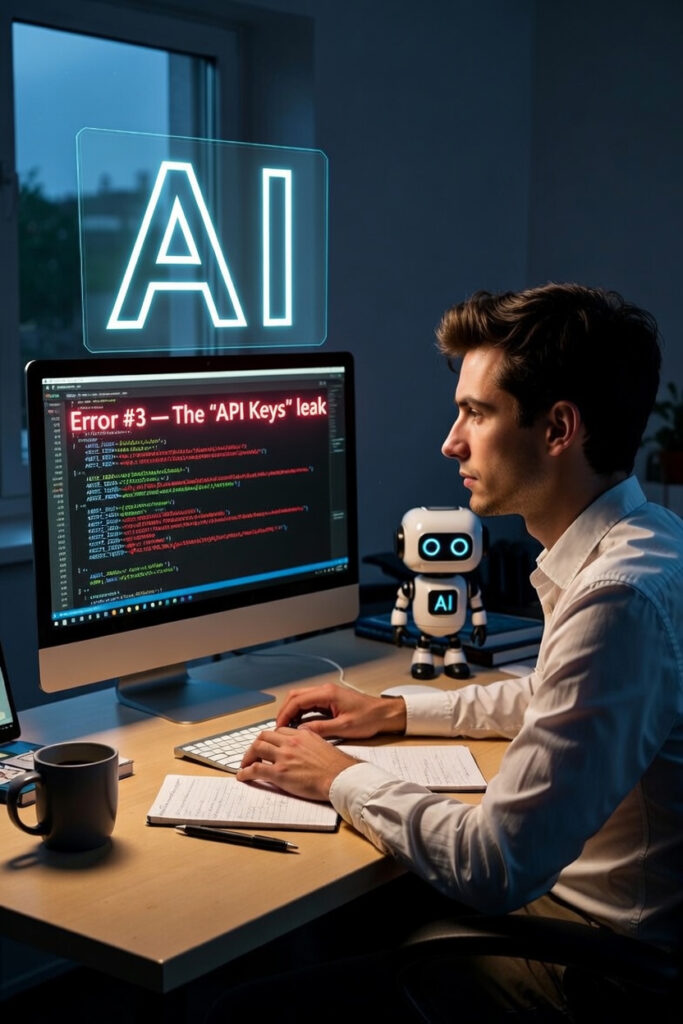
Error #3 — The “API Keys” leak
The problem: Leaving the API key written into the source code or sharing it via Slack/email among developers.
- The danger: Bots constantly scan GitHub. An exposed key can be hacked in less than 4 minutes. Malicious actors can then use your account to generate millions of tokens at your expense.
- The solution: Use Secret Managers (AWS Secrets Manager, Vault). No key should ever appear in your working files. Enable a monitoring tool (like GitGuardian) to block any leaks before they reach the internet.

Error #4 — The "Amnesiac" or "Overloaded" AI
The problem: An AI model does not have natural memory from one message to another.
- The risk: Either the AI forgets what was said two sentences earlier (a frustrating experience), or the developer has to re-record the entire history each time (exploding costs).
- The solution: Selective Memory Management. A “memory window” must be implemented that retains only essential recent exchanges or an automatic summary of the conversation to maintain consistency without breaking the budget.
Error #5 — Flying without a dashboard (The absence of evaluations)
The problem: Relying on intuition or a few manual tests to judge the quality of the responses.
- Risk: AI “hallucinates” (confidently invents facts). Without an automated evaluation system, these errors will go live and damage your company’s credibility.
- The solution: The Golden Dataset. Create a list of 50 critical questions with their expected answers. Automate the testing of these questions with each update. If the reliability score drops, the update is not deployed.


Checklist — The 5 checkpoints before deployment
- Optimization: Do you use RAG to limit the number of tokens?
- Resilience: Can your application handle a 429 error (overload) without crashing?
- Security: Are your API keys masked and protected by a digital vault?
- Consistency: Do you have a memory strategy for your conversations?
Reliability: Do you have a test set (Golden Dataset) to measure hallucinations?
Conclusion

These five mistakes aren’t signs of incompetence. They’re the natural errors of any team discovering a new technical paradigm. The difference between a successful AI integration and one that goes wrong in production often lies in these details—which no one really documents because they’re learned on the job.
That’s precisely why TEMPUS DONUM makes a real difference. Whether you need to structure your existing team’s AI integration or bolster your capabilities with developers who already have expertise in these areas in production, we’re here to help.
Is your team integrating AI? Let’s talk about it. These 5 mistakes are avoidable with the right support. We help teams integrate AI correctly — or we provide you with developers who already master these topics. -> Option A : We integrate AI into your existing stack -> Option B : AI-ready developers available quickly Book a free 30-minute strategy call |